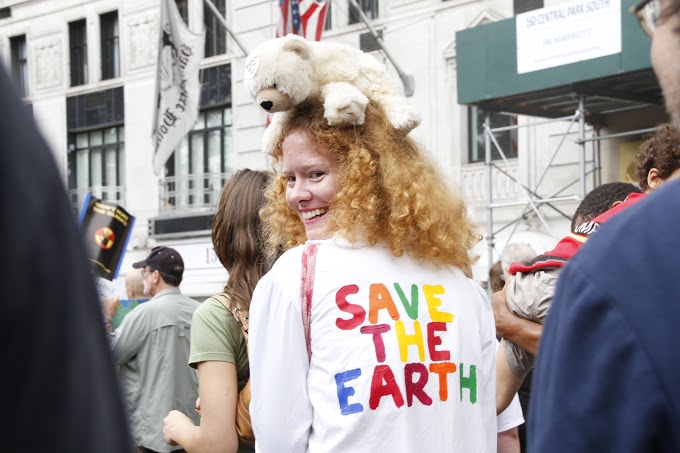
Thousands of people took to New York City’s streets demanding more attention to climate
“There is no planet B”, “Forests aren’t for sale”, “Listen to indigenous peoples”, “Climate change is real, teach science,” are some of the messages written on signs carried by marchers who gathered this Sunday morning in the streets of Manhattan, New York, in what is already being called the biggest climate protest ever. “Who are we? We are the people! What do we want? Climate Justice now!” shouted the crowd of about 300,000 protesters who attended the People’s Climate March. The event happened a couple of days before the UN Climate Summit, which will gather world leaderships to take action and make pledges to stop global warming.
The march was called in by 350.org, Avaaz, the environmental organization founded by the writer Bill McKibben. On the website it was described as “an invitation to change everything.”
Disbelief in the UN meeting was rampant among the demonstrators. Many said they were there to put pressure on world leaders to take concrete action on climate change. UN secretary-general Ban Ki-moon joined the demonstration in an unusual move for a high-ranking official. He appeared next to Al Gore and the English primatologist and anthropologist Jane Goodall.
“I have little hope that something is going to be done about environmental issues, especially by the U.S,” said Brazilian college teacher José Celso de Castro Alves, unaware of the politician’s presence at the event. “This is why we are here today, to show our dissatisfaction concerning climate change and capitalism.”
Others were more optimistic. “I am here because every social change begins when people get together in the streets,” said the biology teacher Elisa Lauterbur. “Together we can be heard and make the difference not only to people but also to the planet.” Lauterbur was one of the hundreds holding a sign asking for climate change to be taught in schools. “Here in the U.S., the schools don’t discuss this subject. There is no understanding that climate change is a real problem, even in the universities.”
If there is one phrase to express the hopes that led people to the streets in that cloudy morning it would be “union is power”. It was sung by the crowd, specifically by hundreds of union workers such as traffic controllers, teachers and health professionals who asked for “green jobs” – work that helps to protect ecosystems and biodiversity and minimize or avoid waste and pollution.
Diverse social groups brought attention to different causes. Judging by the number of signs, one of the most highlighted issues was fracking, a technique that uses clean water to extract gas from deep-rock formations. The process is forbidden in Europe because of its high risk of contamination and environmental impact, but it is commonly used in the U.S. provoking methane leaks into groundwater aquifers.
All the causes
Indigenous peoples from Peru, Mexico and Bolivia, wearing colorful traditional costumes and feather headdresses, sang and played the bongos asking to be listened to and recognized as forest protectors.
A small group of Brazilians who live in New York City asked for attention to the victims of hydroelectric dams in the country, most of whom are indigenous. “We want climate justice, we want the rights of the dams’ victims to be respected and we want the Brazilian government to approve the ‘National Policy and Rights for the Populations Affected by Hydroelectric’, which has been waiting for Congress’s approval for years,” a university student, Saulo Araújo said.
A 100 inch Noah’s ark made of card boxes emerged in the sea of people, inside of which was a woman wearing a veil and a group of men dressed as priests and Mormons. “The end is near for the human race,” they shouted. A big sign in the ark said “People of faith against climate change”.
One minute of silence
An incredible profusion of indigenous drums, metal band songs, and prayers filled the air during the progression of the march for 44 blocks, from west 86th Street to 42nd Street, Times Square. Arriving in the temple of consumption, illuminated by its enormous outdoor LED signs, the protesters fell silent.
With arms raised, they stood for one minute of silence to honor the people affected by climate change. In a city recently affected by Hurricane Sandy, the moment of drama drew tears from some people. “New York has seen closely what global warming can do and we don’t want to see it again,” said Danielle Horton, who had her house destroyed by the storm. “We don’t want no one to go through what we have been. That is why I am here today.”
* This post was originally posted in Portuguese here
More pics:
 Sofia Moutinho