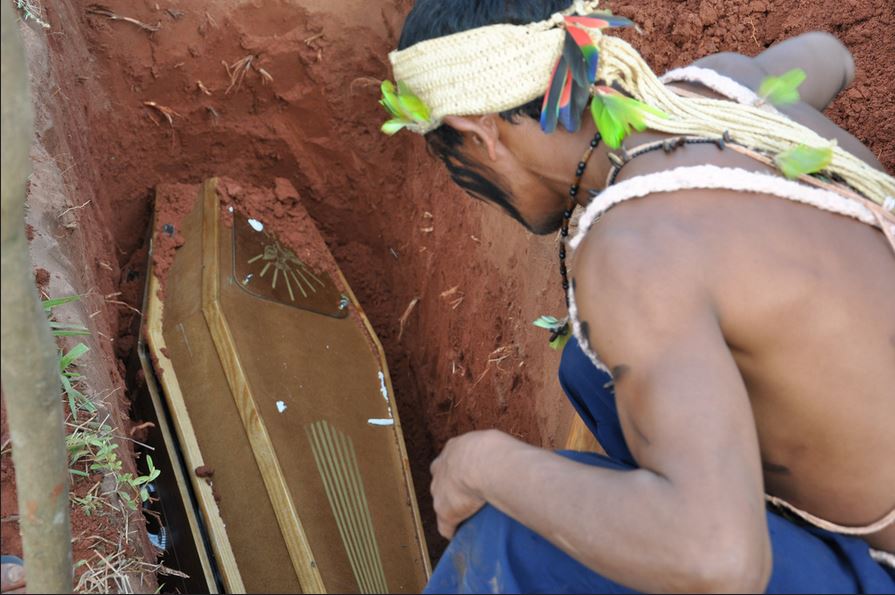
Brazil is far from being a high suicide rate country. The rate of ‘self-induced death’ in the country is close to 5 per 100,000 – six times lower than the average observed in countries where suicide is a big problem like Lithuania and South Korea. However, the reality is completely different when it concerns the indigenous peoples from Brazil. Among the natives, suicide rates are 20 times greater than those observed among non-indigenous.
Almost all deaths are from hangings, mostly young people and children. According to specialists who study the matter, they are victims of a social problem profoundly linked to land disputes and poor health and living conditions.
To show this suffocated nation, this silence genocide, I wrote a story for the magazine I work for, Ciência Hoje. I have tried to listen as many specialists as possible, as well as indigenous peoples themselves and government official sources. But I didn’t stop there. This work is my first try on the new tendency of ‘data journalism’, using data to tell a story. I have spent months gathering data on the subject. In Brazil, the Ministry of Health is the organ that holds the information on the number of suicides among indigenous and non-ingenious. But the Ministry was not cooperative and did not’ seem to want to publicize this problem. I did several tries asking for data and for interviews, but they ended in nothing. In fact, I often had listen from the Minister’s press office that “suicide isn’t a subject that people want to hear about” and that should not spend mine on that.
So I had to appeal to the Brazilian’s Freedom of Information Law, which pledges that all citizens have the right to access data held by the national government. With this approach and other efforts, I was able to gather the data I needed to build a general panorama of the indigenous suicides in Brazil. It resulted in an interactive map showing the indigenous suicides occurrences from 1996 to 2012 in Brazil. The map shows the main focus of the problem, the total number of deaths by county, as well as the proportion of indigenous suicides and non-indigenous ones.
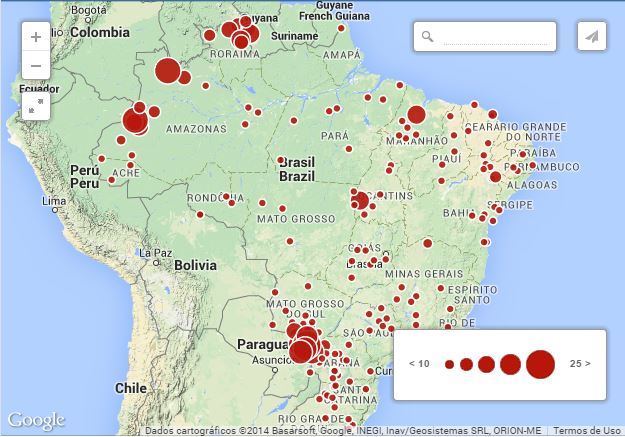
Some places stand out on the map, like the county of São Gabriel da Cachoeira, an Amazonian region in the Amazon state. There, 76% of the population is indigenous and 95% of the suicides are indigenous. It means that an indigenous who live there has about five times more chance to commit suicide than a non-indigenous person does.
São Gabriel da Cachoeira is just one example. Many other locations, especially in poor and isolated areas of the North and in the West of the country show high rates of indigenous suicide. In the indigenous land of Dourados, in the Mato Grosso do Sul state, in the west of Brazil, 14,000 guarani-kaiowá Indians live squeezed in 375km2 – a population density of 3,4 people per square meter. The place holds a suicide rate bigger than any country in the world: between 90 and 75 deaths per 100,000.
With the numbers in hand, I wrote an extensive story on the subject. The story is published in Portuguese in the magazine Ciência Hoje and on its website.
An English version can be found here.
 Sofia Moutinho