A community in the Brazilian Amazon shows how to preserve nature and keep economic development. The case, however, is still an exception in the region.
_CIENCIA HOJE
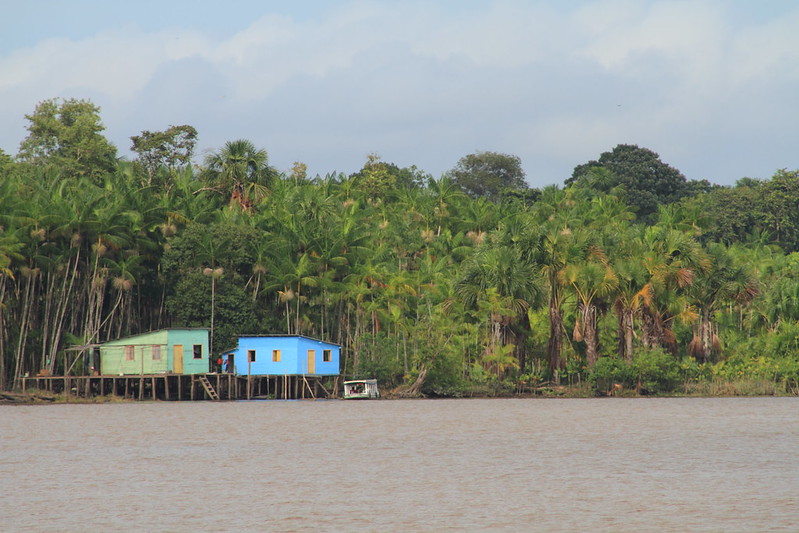
When in a boat on the Amazon River, the largest volume of water by discharge in the world, one may mistake it for a brown ocean. From one side, it is not possible to see the other side. The repetitive palette of green of the trees on the shore gives an impression of calm and immutability. Except for the water and some birds, nothing seems to move. Among the vegetation, rustic wooden stilt houses rise on piles over the river. Forty families live in them, forming the agroextrativist community of Ilha das Cinzas, located at the north portion of the river. Families have been living in the area since 1980, exploiting wood, local fruits, such as the açaí, and fishing, both comercially and for subsistence.
The island is 26 hours by boat from the state capital, Belém. The only way to reach it is by water. No signs point the way and there is no public illumination. However, the community is not as isolated as it would seem. They access the internet via satellite on shared computers and use electrical energy produced by diesel engines to watch TV at night.
This modest prosperity and connectivity with the external world came from a drastic change in their relationship with nature and land use. Ten years ago, the families on the island were under the control of the patrão (boss in Portuguese), a common figure in the Amazon region, referring to someone who holds the power of the land and the commercial transactions. The patrão pressured the natives to harvest açaí fruits, wood, fish, and shrimp only for him, claiming that he was the owner of the lands they were occupying.
Since they did not own the property, they sold what they grew or produced to him at a low price and also paid him taxes to stay on the land. The patrão did not have the title to the land either but had shown them a false property document. In the end, the patrão profited from the taxes, from the sale of the goods at a low price, and from trading these.
“I don’t know who he was. We only talked to an intermediate person. But this happened for
years”, explains one of the island habitats, Antonio Oliveira, 54-years-old, known as “Baixinho.” “When my father was young that is what happened: the patrão used to buy the work tools for us and let us live on his alleged land. We could only sell our products to him and in the end, we gave it for free, since we had to pay for the land use and the tools.”
The situation he describes was not exclusive to Ilha das Cinzas. According to the agronomic
engineer Jorge Pinto, who has worked with Amazon communities for more than 10 years, this kind of relationship between natives and landowners has been happening since the 19th century when latex was the main resource produced in the region. “The latex exploration promoted colonial occupation in the area, made the extractive system thrive, and created this patrão figure that we see today everywhere in the Amazon,” he says.
The story began to change on the island in 1997 when the local population organized a workers association called Associação dos Trabalhadores Agroextrativistas da Ilha das Cinzas (Ataic) aiming to improve their resources and legalize their land use. before this, they had been exploiting the surrounding natural resources without any control. The ecosystem was being impacted. The uncontrolled fishing had led to a fish reduction in the area and the native shrimp camarão-de-agua-doce had disappeared.
The locals started to modify their fishing tools to reduce environmental impact. Instead of
using nets with small holes that used to catch fish of all sizes, they adopted a traditional fishing trap that had been used by their indigenous ancestors. Known as marapi, the trap is a cone-shaped basket made of small strips of wood by the local woman. It has two openings that enable shrimp to enter but not to leave. A piece of the local sweet-bitter fruit babaçu is put inside to attract the animals.
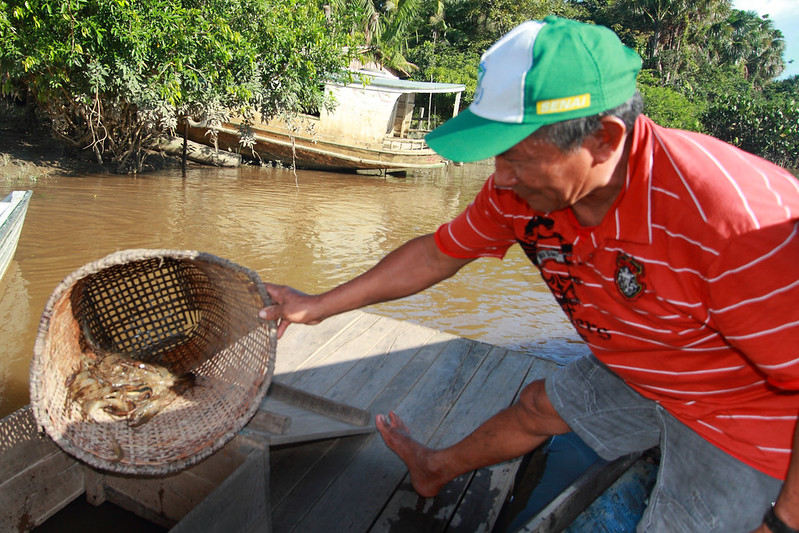
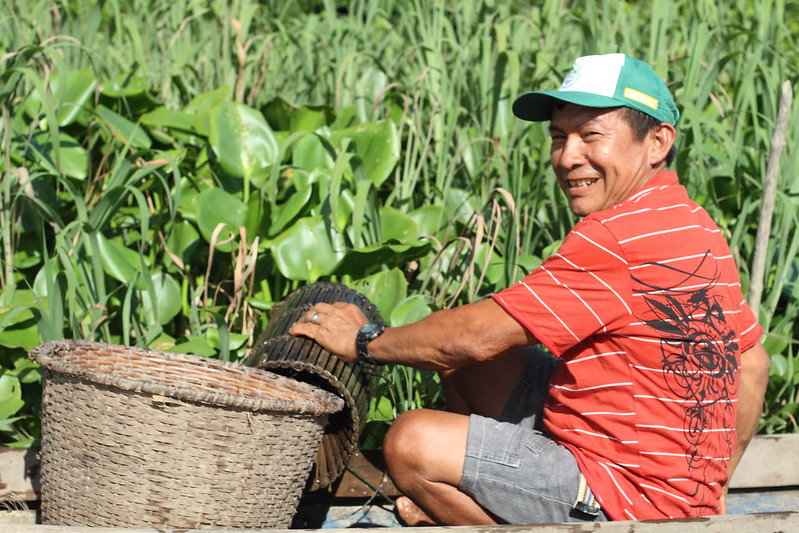
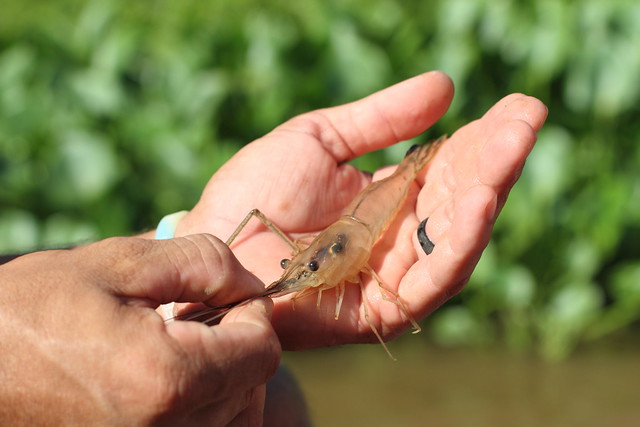
After the community began to gather in the association, they even improved the trap so that
only large adult shrimps are caught now. Young shrimp remain free to grow up and multiply.
They also began to use floating farms that allowed them to increase their production. Now they sell higher quantities and bigger shrimp without harm to nature. The medium size of the shrimp they captured in 1997 was 4.5 cm. Today it is 9 cm. The price of the shrimp also rose with the changes: from 0.80 reais per kilo to 10 reais.
To make sure that the commercial activities would not harm the environment, the locals established a limit of 70 traps for each family. They also decided that the fishing period would be constrained from May to December.
“This was a community decision. There is no law about shrimp fishing, but we thought it was a good call,” says the agroecologist Francisco Malheiro, Baixinho’s son, born and raised on the island. “Both we and nature gain this way. Using 70 traps, today we fish what we could only fish using 150 traps before the changes. Now we apply 20% less effort and end up with more shrimp.”
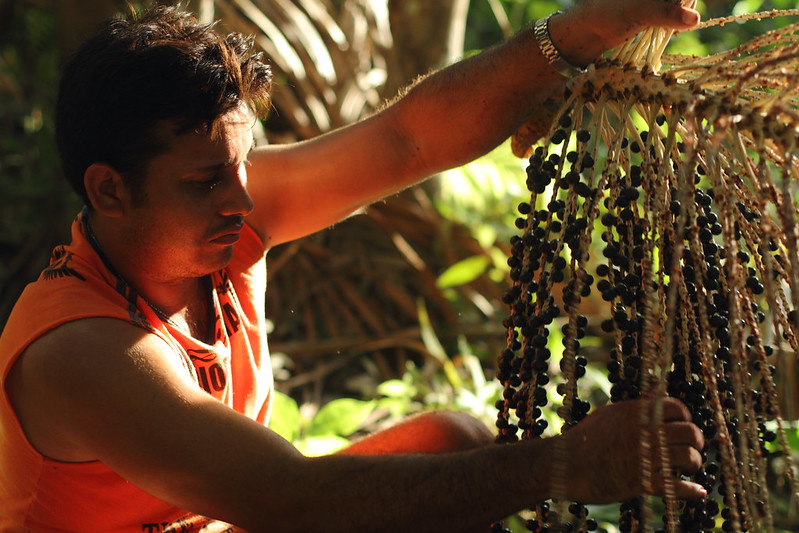
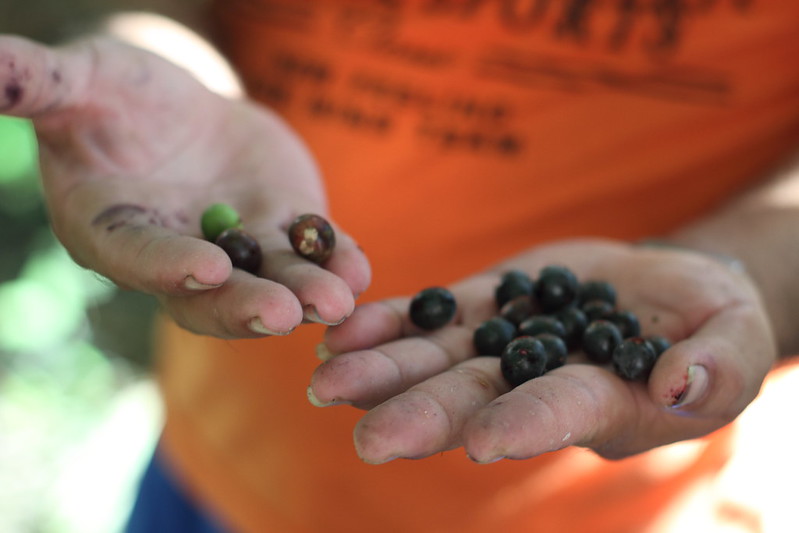
The community uses the extra time they gained to collect açaí. The typical fruit, recently trendy in frozen yogurt shops in the US and Europe, is part of the local’s everyday meals consumed as a savory paste. They do not plant the açaí palm. They use simple techniques to collect the fruits from the palm trees that naturally grow around them. Today they sell a 60 kg bag of açaí to the surrounding communities for 80 reais. They earn 16,000 reais per year on the sale of açaí.
All the changes created by the community were formalized in a document presented to the government to legalize their land use. It is a necessary step to transform the village into a formal “sustainable community”. The legal process began in the 90s and the application was only accepted in 2004 when all families on Ilha das Cinzas were given land use rights.
After the legalization, the locals started to receive monetary help from the government to build houses and apply for other social benefits. This is how they got the 15 computers they use to access the internet. The funds also gave them the chance to improve education among children and adults, who take online courses. The legalization of the land also attracted private companies interested in financing local projects as part of their social strategy. “This case shows us that significant improvements in economic status are possible with the sustainable use of the rainforest,” says the former director of the Brazilian Forest Service, Luis Carlos Joels.
Local leader Josi Malheiros believes the change was only possible because of the community total involvement. “Since we organized everything changed, from our relationship with the authorities to the environment”, he says. “We showed that sustainable development is not only about forest preservation but also concerns the social aspects of those who live in the forest.”
Challenges to overcome
Pará is the Brazilian state that concentrates the most varied land-use regimes aimed at traditional communities. The Gurupá locality, where Ilha das Cinzas is located, has communities under the eight possible kinds of official sustainable or traditional land regimes allowed in Brazil. According to a study conducted by the local workers association ‘Sindicato dos Trabalhadores e Trabalhadoras Agroextrativistas de Gurupa’, 99% of the state territory is in the process of land use legalization through community efforts. The local population presence in the forest is a way of forest preservation. It is estimated that 96% of the forest in the region is preserved.
The local situation does not differ from the national scenario. According to a report published by the NGO Rights and Resources, Brazil is a global leader in the recognition of Indigenous Peoples and Community Land Rights in the forest. These groups control 1.5 million km2 of forest. To the international law specialist Fernanda Almeida, one of the authors of the study, this was possible due to the judicial efforts made globally after the United Nations Conference on Environment and Development (ECO92). Since the conference, the total forest area under the control of traditional communities in Latin America, Asia, and Africa has risen from 21 to 31%. Globally, it has grown from 10 to 15%.
“From 1992 to today we have been changing the way we approach forest use,” she points
out. “No one would think that to preserve the forest we should have people living inside it. However, the traditional communities have shown that having people living in the forest not
only preserves nature and biodiversity but also preserves their way of living and helps the
economy grow.”
Despite the advances, there are still many challenges to overcome. Even if some communities like the one in Ilha das Cinzas have achieved economical sustainability, most of them still lack basic needs such as access to health, public electricity, and sewage treatment. The energy used today to move boats and light the houses comes from pollutant diesel engines paid for by the inhabitants.
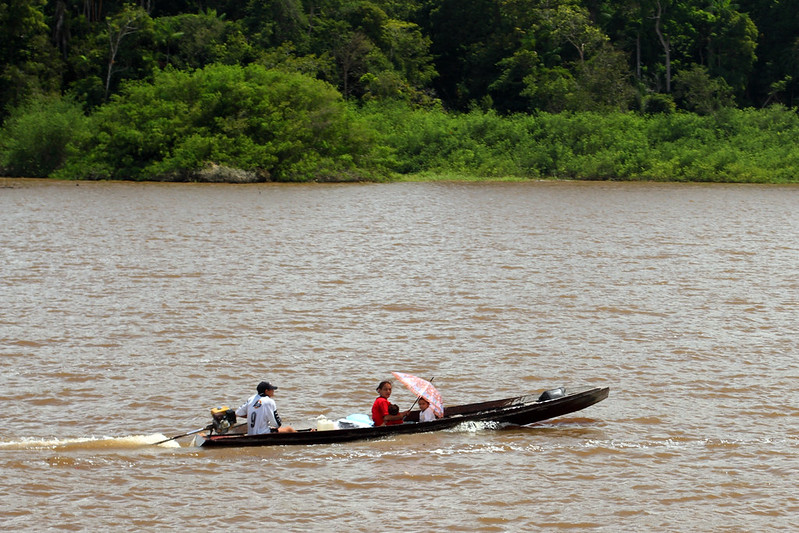
To have four hours of electric light per day, the locals spend around 400 reais per month (90% of the national minimum wage). The closest gas station where they can buy diesel is six hours away by boat, in the neighboring state of Macapa. Sewage is thrown directly into the rivers.
The lack of supervision and support by the government is also a major problem, especially in communities that lay inside formal conservation areas. This is the case of the Reserva de Desenvolvimento Sustentável Itatupã-Baquiá, the first federal reserve created in the country, set in 2005 between the north portion of the Amazon river and the Gurupá Canal. The community began to come together as a unit in 1980. Manuel Corsdovaldo Chaves de Souza, known as Codó, was one of the leaders of this movement. He gathered the local inhabitants, created an association, and started the process to legalize their occupation in the forest, which goes back to decades ago when their ancestors reached the region to exploit latex.
Today 70 families live in the reserve, on what nature provides. Most families cultivate açaí and other native fruits and nuts, such as the Brazilian nut. They consume and exchange the fruits with the neighbor communities for other goods, since commercial exploitation of the forest or the river is forbidden inside the reserve. In the document they had to submit to the government to have their land use legalized, they established many norms, such as limits on fishing amounts per family. One of the rules prohibits the use of motorized boats in some parts of the river surrounding the village, to avoid pollution and the visit of outsiders looking to fish there.
However, the norms are not followed by everyone and the government representatives are not present to inhibit violations. So it is left for Codó, today 65-year-old, to try keeping some order. He holds a diary where he writes down all the infractions he sees. In the wrinkled pages, he writes about people fishing with motorboats, doing illegal logging, and burning the forest to give space to plantations. But his notes have no value. The ICMBio, the governmental institution that should be
monitoring the region, have one official responsible for the 6,500 km2 of the reserve.
“I do what I can, but the government needs to do its part to avoid and reprimand violations,” claims Codó. “To me, it is a very difficult situation. There are many people in the community against me because I complain when I see something wrong.”

Science and economic development
The balance between development and sustainability achieved by the Ilha das Cinzas is still a challenge for most of the villages in the Brazilian forests.
To the current director of the Brazilian Forest Service, Antonio Carlos Hummel, the economic exploitation of the forest deserves more attention. “Our focus should be on developing
policies that improve the economy in the legalized communities and value the forest products,” he says. “This is only possible if we have an economic incentive for sustainable forest practices and actions to support the local communities so they can keep living in the forest without harming the environment.” He argues that the traditional communities living in the forest should receive the same tax benefits as the agribusiness owners receive.
This is also the vision of the Brazilian Academy of Sciences. In a recently published document about the Amazon forest’s future, the scientists from the institution highlight the importance of the green economy and the need to include science in the debate.
“It is possible to have a sustainable model of consumption of natural resources in the Amazon Forest that allows not only the social and economic development in the region but also nature’s and traditional communities’ preservation,” the document asserts. “We can only keep the forest intact if we attribute economic value to it. This is the only way to compete with other practices that cause destruction. We need science, technology, and innovation to show us how to use nature without destroying it.”
*This story was originally published in Portuguese in the printed version of the magazine Ciencia Hoje in July 2012.
 Sofia Moutinho