A 3-decade partnership between archaeologists and the Kuikuro people offers a model of collaboration—and documents the complexity of early Amazonian societies
_ SCIENCE
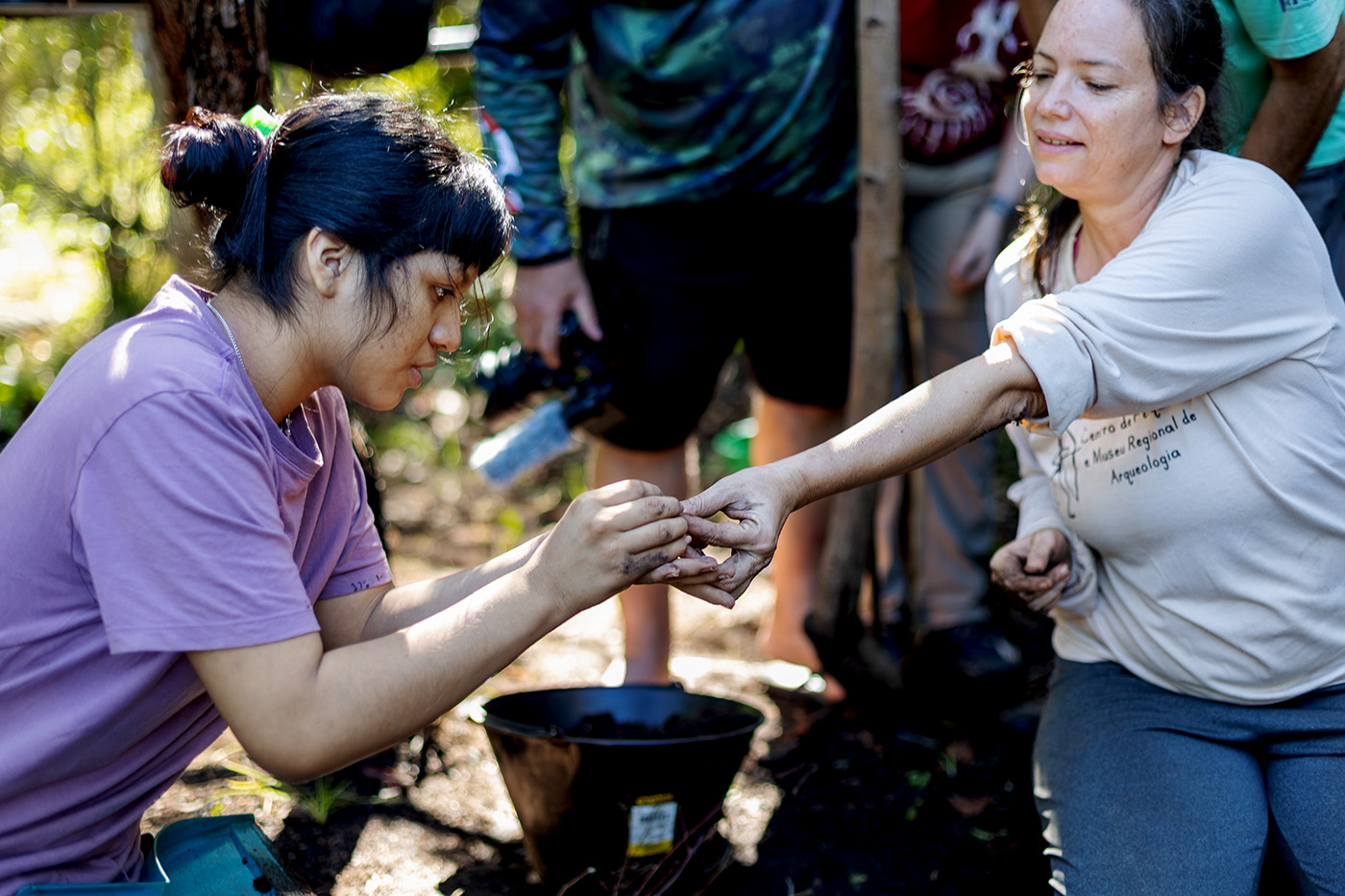
Xingu Indigenous Territory, Brazil—Yamána Kuikuro, 14, kneels barefoot beside a shallow, half-meter-square pit in the forest. The site, a few kilometers from her own hut in Ipatsé, a Kuikuro village in the Xingu Indigenous territory, was once the backyard of her great-grandparents’ house. As she scrapes the brown earth with a trowel, she soon spots a black ceramic shard. It is only about the size of her palm, and this is her first day ever on an archaeological excavation. But she immediately recognizes what the object once was.
“It’s an alato,” she says, showing the piece to a group of archaeologists and other Kuikuro who have gathered to watch the excavation in the village of Anitahagu. An alato, Yamána explains, is a large pan used to cook beiju, a white flatbread made with yucca flour that’s eaten almost every day in her village. Her grandmother still has one in the backyard fire pit where she prepares most meals, just as countless Kuikuro women did before her. This alato likely belonged to her great-grandmother on her mother’s side.
“Everything here has a history and a name,” says archaeologist Helena Lima, who is looking on. “We just have to listen to the Kuikuro and then guide the research based on that.”
Lima, who works more than 2000 kilometers and up to three travel days away at the Emílio Goeldi Museum of Pará, in Belém, is leading a 2-week scientific expedition here in the southeastern Brazilian Amazon, as part of a partnership between archaeologists and the Kuikuro people. The project began to take shape in the 1990s, when archaeologist Michael Heckenberger of the University of Florida started to work—and publish with—the Kuikuro, a rarity at the time. Together, they have been exploring the history of Indigenous occupation in the Upper Xingu region of the Amazon, a transition zone between the savanna and the rainforest, and home to many Indigenous groups.
The project has helped rewrite a common Western narrative around the Indigenous presence in the Amazon. The archaeologists and the Kuikuro have documented the long history of a large and sophisticated civilization that prospered here for at least 1500 years—up to the arrival of Europeans in the Americas. In half a dozen papers—mostly in top journals such as Science and Nature—they have traced the outlines and activities of a cluster of ancient cities that were laid out following the same structure of modern Kuikuro villages, but far larger.
The pioneering collaboration has inspired other researchers, says Eduardo Neves, an archaeologist at the University of São Paulo who is leading a mapping project elsewhere in the Brazilian Amazon. Neves now also engages local communities in his studies. “People are starting to talk about involving local communities now, but Heckenberger and the Kuikuro were already doing it decades ago,” Neves says. “This is a wonderful case that was only possible because of a relationship of trust, and it serves as a reference for us all.”
 Sofia Moutinho