Dramatic underwater photos capture the elusive Amazonian pink dolphins red-handed.
_BBC
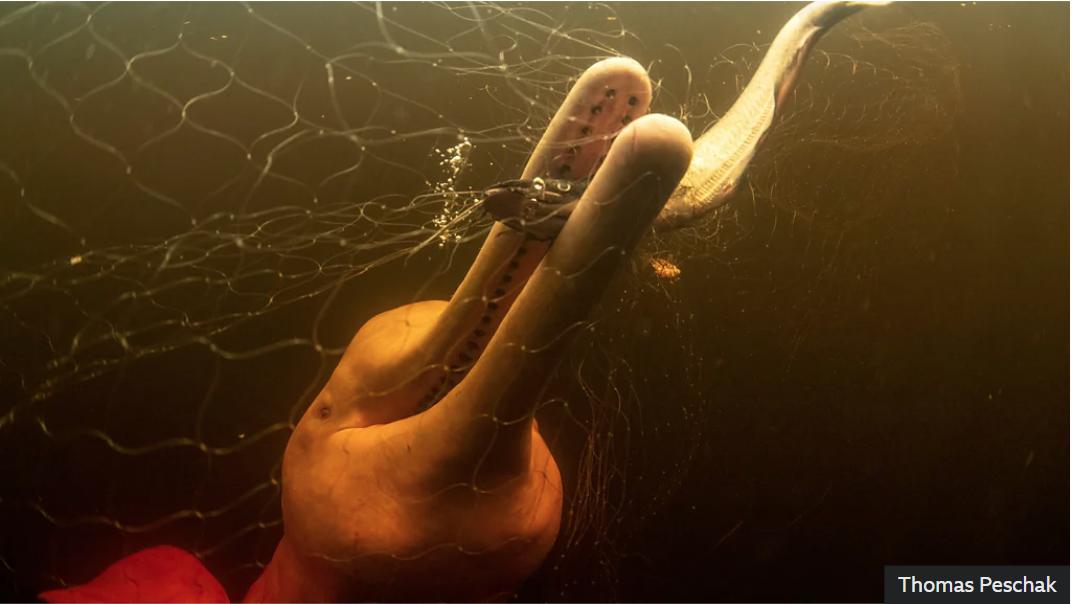
In 2023, as the Sun was about to set, photographer Thomas Peschak entered the black waters of the Rio Negro River in the Brazilian Amazon. With his camera in hand, he waited for the perfect moment to catch a thief in the act. As fishermen cast their nets into the river, suddenly a sleek pink shape emerged from the depths, swimming toward the trapped fish. Peschak held his breath underwater and started shooting. Moving quickly, the creature – an Amazonian pink river dolphin – poked holes in the net and stole a catfish.
“They are very agile and can manoeuvre with incredible exquisiteness around these nets underwater,” Peschak says. “They are great thieves!”
At the time, Peschak knew he was documenting something no one else had managed to capture on camera. These dolphins have learned to associate the nets and the sounds of fishing boats with an easy meal. Peschak is the first photographer to document this behaviour underwater.
The lack of precise information on where to find these animals and the poor visibility in the muddy waters of the Amazonian rivers were major challenges, he says. But Peschak, who has worked as a marine photographer for over 20 years, drew on his expertise in ocean documentation. “In most of these rivers in the Amazon, no one has ever dived to photograph before,” he says. “There’s no map, no description. You basically have to go underwater and figure things out for yourself.”
The photos earned him the photojournalist story award at the prestigious Wildlife Photographer of the Year Award in 2024.
Known locally as boto in Portuguese and bufeo in Spanish, the pink river dolphin is a funny sight. With its melon-shaped head, rose-coloured skin, and slender, hundred-toothed snout, it is the largest freshwater dolphin in the world, growing up to 2.5m (8.2ft) long and weighing as much as 200kg (440lbs). Four types of pink river dolphins live in the Amazon River basin. All of them are endangered, facing significant population declines in recent decades due to hunting, entanglement in fishing nets, pollution and droughts.
Like other dolphin species, they use echolocation to “see” by emitting clicks and interpreting the returning echoes. But the bump on top of their foreheads, called a “melon”, serves as an extra aid in navigating their murky environment, functioning as an amplifier for sound and helping them create a mental map of the water, its obstacles and prey.
The dolphins’ unusual body shape, skills and intelligence have contributed to rich folklore about them. Many indigenous groups and river communities throughout the Amazon rainforest share stories of the boto living in an underwater world with vast cities deep inside the rivers. Other tales, less sympathetic towards the animal, claim that the dolphins can transform into humans. At night, they appear in villages disguised as pale men who seduce and kidnap young women.
The reputation of a thief, whether of women or fish, has made life difficult for the pink river dolphin, according to Peschak. While revered and respected by Indigenous communities, the dolphins are sometimes feared by some people for their magical powers and often considered enemies by fishermen, he says. That is because the dolphins regularly steal the fishermen’s catch and damage their gear, making it not unusual for fishers to hunt, injure, and deliberately kill these animals.
“There are communities where fishermen will actually kill these dolphins out of revenge,” says Peschak, who photographed these animals during a two-year-long National Geographic expedition to study and document the Amazon River Basin. He accompanied several scientists who travelled from the Peruvian Andes, the source of the Amazon River, to the Atlantic Ocean.
On his journey, Peschak witnessed several threats to the dolphins, including the rage of fishermen against the animals, and accidental bycatch. Even when the dolphins are not intentionally attacked, their proximity to fishermen can be risky, he says. Some animals end up hurt by the boats’ propellers, while others become entangled in the nets and drown, he adds.
“The nets are our main concern,” says marine biologist Fernando Trujillo, who has spent more than 30 years researching the South American river dolphins and accompanied Peschak on the expedition. “Every year, in a small area in Colombia alone, we have more than 17 dolphins dying because of the nets,” says Trujillo, who is a member of the Colombian Academy of Exact, Physical, and Natural Sciences.
 Sofia Moutinho